
My Journey Through Union World: A Memoir
My Journey Through Union World: A Memoir, by Jeff Eichler (Morrisville, NC; Lulu Press, Inc., 2025)
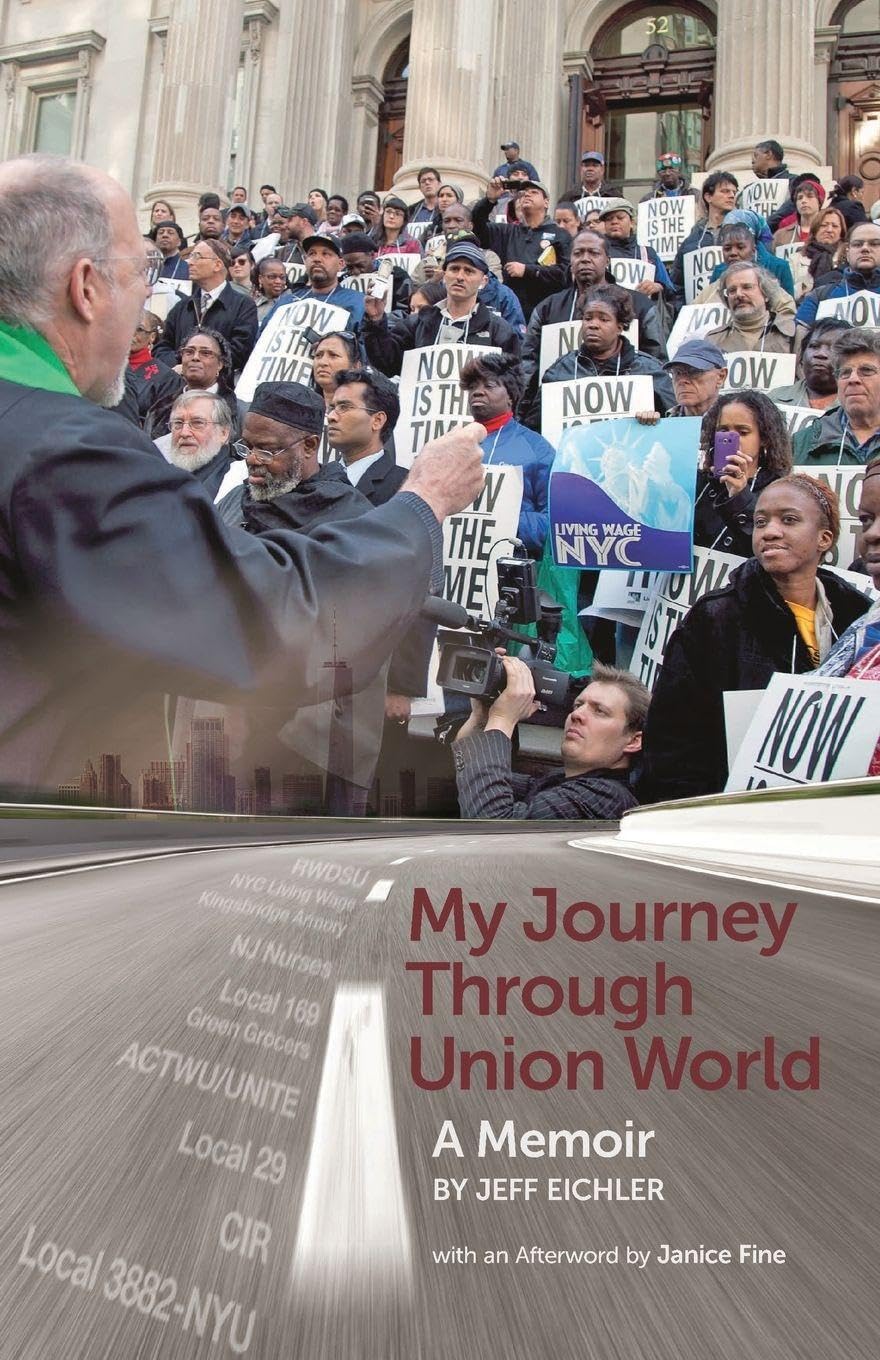
It is a pleasure to be asked to review my friend Jeff Eichler’s book, My Journey Through Union World: A Memoir, a calmly written but unsparing look at the inward-looking, bureaucratic and ossified world of much of the labor movement Jeff experienced. Within these confines Jeff worked for some 30 years as a rank-and-file organizer and union staffer (largely in the New York Metropolitan Area), and most important, an advocate for a broader, more inclusive “social unionism” that seeks to organize the working class and its communities and civil society institutions into militant entities that will address the full range of labor/working class issues, both through democratic unions based upon shop steward-based governance, and via broader social movements. Jeff’s memoir depicts a valuable slice of a century’s worth of the ongoing struggle of U.S. labor and the Left to build a more just society.
I have placed the table of contents for chapters 4-8 below (chapters 1 and 2 detail his familybackground and early education), to give a sense of the variety of Jeff’s work. However, I will concentrate on chapter 3, where I first met and worked with Jeff at NYU, and on chapters 9 and 10, where Jeff details his at-times poignant but ultimately unsuccessful efforts to build a model of vibrant social unionism, from 2004 to 2012.
When Jeff came to work at NYU’s Tamiment Library, he envisioned a tranquil environment that would allow him to finish his PhD in history, “Utopian Attitudes Toward Work in 19th Century America.” Jeff kept above his desk the 17-step diagram of how to fold an apple, symbolic of the level of social control in that particular utopian community. However, the goal of completing the dissertation itself became utopian, so to speak.
NYU’s technical and clerical workers had just been successfully organized as the United Staff Association, Local 3882, by NYSUT (the New York State United Teachers Union). There quickly followed an internal struggle to change the union’s governing structure from the traditional hierarchical one to a democratic shop steward-led model, in which each of NYU’s many subdivisions would choose its own shop steward, and the collective would become the union’s executive board from which the several officers – president, secretary, treasurer (eventually me), and chief steward (aka organizer) would be elected. Jeff, imbued with his family’s vision of a militant democratic union movement, quickly threw himself into this ultimately successful struggle, and quickly emerged the one indispensable person within the union and was eventually elected Chief Steward. Then, the union had to negotiate its first contract in which it won a grievance procedure and the elimination of the two lowest pay grades. The outstanding problem facing the local was the high rate of staff turnover. Since we did not have either a union shop or an agency fee contract, we had to spend most of our time and energy recruiting new members. We realized we needed a full-time organizer, and in July 1984 Jeff resigned from NYU to take on this new, modestly paid, and demanding position.
In our next contract negotiations, in 1987, we put the issue of the agency fee at the center of our demands. NYU did not agree, and in the summer of 1988, we went on strike. It was Jeff’s prescient understanding at the time of the strike that even if we didn’t win the agency fee, the strike was the foundation for the union’s eventual success on this vital issue. While we did not win on this issue, the strike laid the groundwork for NYU’s eventual acceptance, almost a decade later, of this demand at a subsequent negotiation (NYU wanted to avoid a second strike), after Jeff had left NYU at the beginning of 1989, ironically in part over the frustrating difficulty of obtaining a union shop or agency fee contract agreement with NYU.
Chapters 4 through 8, listed just below, brought Jeff into a variety of union environments and workers representing the targets of organizing drives:
Chapter 4, 1989: Into Union World: RWDSU Local 29 – Chapter 5, 1989-1995: The Committee of Interns and Residents – Chapter 6, 1995-1999: Amalgamated Clothing and Textile Workers Union/Union of Needletrades, Industrial and Textile Employees – Chapter 7, 1999-2002: First glimmers of another world: Local 169, Organizing immigrants in the gray
economy – Chapter 8, 2002-2004: Hiatus among the Nurses.
If there was a pattern to these years, it was one of modest victories and defeats, long working hours (60-hour workweeks were not uncommon) and increased awareness of the darkening shadow of “union world” unionism. Jeff worked with a variety of workers, from skilled nurses to struggling illegal immigrants. Throughout his career, Jeff exhibited a deep respect, sympathy and empathy for all workers, regardless of their social station, and an ability to maintain an equanimous perspective through often-trying times. Fortunately, Jeff had the unwavering support and sound judgment of his wife Sue Leung Eichler, who had her own demanding career. She was a social studies teacher and later an assistant principal.
Chapters 9 and 10 tell the story of ambitious campaigns to bring about a new model of unionism. Jeff reached out to community organizations and clergy, with the reluctant consent of his union’s leadership. The campaigns achieved several significant local organizing victories, and campaigns against violations of labor law such as the failure of companies to pay back wages that they owed. Efforts were made to revitalize existing locals whose members had never even seen the union officials who were responsible for ensuring contract agreements, let alone organizing new workers. Most ambitious were efforts to organize neighborhood-wide campaigns and even a city-wide Living Wage campaign. While these campaigns met with initial success, they were ultimately undermined by union officials who wanted to “control” their members, many of whom they had never even met.
Ultimately, these efforts were undermined by union leadership who feared a mobilized membership, and who did not want to share credit for success with other organizations. Sometimes the campaigns were undermined by cozy agreements with New York City officials and elected officers, so the “benefits” of such agreements were hollow. Below, for consideration of length, I have placed the full chapter headings and subheadings for chapters 9 and 10 to give the reader a feel for the breadth, depth and audacity of the efforts of Jeff and his union and community comrades in struggle.
Chapter 9, 2004-2012: Union World reshaped: the Retail, Wholesale and Department Store Union, part 1: Beginning the work – A different direction – Cookie’s, the first indicator – A city wide effort? – Retail Action Project and its campaigns – A different model of unionization.
Chapter 10, 2005-2012: RWDSU part 2: Two campaigns: Kingsbridge Armory; Living Wage NYC – Background – Enter the trades – Moving forward – Our Community Benefits agreement – The campaign intensifies – Betrayal – Victory? It’s complicated. Living Wage NYC – Developing the campaign – The campaign – Falling Apart – The end – Departure into retirement.
After one betrayal too many, Jeff, who was reaching retirement age, resigned from his RWDSU position.
The book may be purchased as a paperback ($28) or as an E-book ($3) at lulu.com/shop, or Amazon.com ($28).
Afterword
The Afterword is by Janice Fine, Rutgers Professor of Labor Studies and Employment Relations and Director of the Workplace Justice Lab. When she teaches she usually assigns Knocking on Heaven’s Door by labor historian Lane Windhams, whose thesis is that the labor movement was alive with experimentation…even in the face of industrial decline, abysmal labor laws and epic union busting. However, as a corrective, she now plans to assign Eichler’s My Journey Through Union World as well. Thus, like the Roman god Janus, the labor movement faces in two directions, and only time will tell which vision will become the dominant one.
Reviewed by Peter Meyer Filardo. MA, MLIS
Archivist and collections assistant at Tamiment Library NYU, 1979-2012
Treasurer and Member of the Executive Board of the NY Labor History Association
[The views and opinions expressed in this review, and in all others posted on our website, are solely those of the reviewers and do not necessarily represent those of the New York Labor History Association. In this instance, a draft of the review was also edited by the author of the book being reviewed.]