
An Irish Passion for Justice: The Life of Rebel New York Attorney Paul O’Dwyer
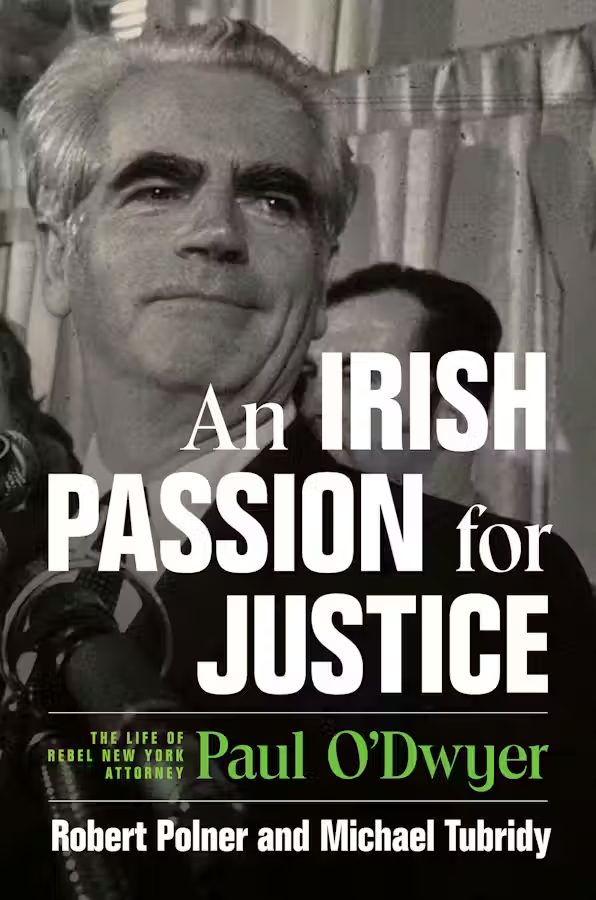
An Irish Passion for Justice: The Life of Rebel New York Attorney Paul O’Dwyer. By Robert Polner and Michael Tubridy. Ithaca, NY: Three Hills, Cornell University Press, 2024. 459pp. $36.95.
Mention the name of Paul O’Dwyer to a New Yorker younger than forty and you’re likely to get a blank stare. Repeat the exercise with more seasoned residents of the Big Apple and you will observe a more animated reaction, one accompanied by either a deep sigh of nostalgia or a somewhat menacing glare. O’Dwyer, an important figure in New York politics for half a century but not particularly well-remembered today, had a gift for speaking his mind and acting in accordance with his conscience. His energetic righteousness inspired many but wearied others. Journalists Robert Polner and Michael Tubridy—keen observers, respectively, of New York politics and Irish-American life—assigned 84 AMERICAN CATHOLIC STUDIES VOL. 136, NO. 1 (SPRING 2025) themselves the admirable task of explaining how and why O’Dwyer earned a place in New York political history in the last century despite never holding a truly meaningful office—indeed, like the Buffalo Bills, William Jennings Bryan, and Napoleon Bonaparte, he is better remembered for his losses than his victories. (The authors would likely argue that O’Dwyer’s four years as president of New York’s City Council in the 1970s qualify as a meaningful term in office, to which one must respond by noting that the office was summarily shut down and eliminated in the early 1990s. The electorate’s lamentations were notably muted.) The authors assert that O’Dwyer must be understood not as a traditional politician—though he sought and clearly wished for success at the ballot box—but as a man with, yes, an Irish passion for justice. At first glance, this might seem like a bold claim, magnified by a bit of chest-pounding and perhaps unseemly ethnic pride. The authors, however, make a strong case that O’Dwyer’s pursuit of justice as a lawyer, civil rights advocate, and political figure was the end product of his coming of age in revolutionary Ireland and his interpretation of the Irish-Catholic experience in America. The authors write that this schoolteacher’s son from County Mayo “would carry the aroused grievances and dichotomies of the Irish experience with him to America as a bona fide Irish republican who glimpsed parallels with the Irish experience wherever he went in his adoptive country” (23). During his seven-plus decades in New York, O’Dwyer gained fame— and no small amount of unpopularity among some of his fellow Irish Americans—for his advocacy of unpopular and often very left-wing causes and people. In the authors’ telling, O’Dwyer’s sense of what it means to be Irish—what it meant to live in the shadow of Britain’s imperial power—explains why he supported the civil rights movement in America, defended leftwingers during the McCarthy era and beyond, aligned himself with the Irgun during its armed campaign to establish a Jewish homeland, denounced the Vietnam War long before it was fashionable, and managed to be both a supporter of the Irish Republican Army during the Troubles in Northern Ireland in the 1970s and ’80s and a defender of the rights of Protestant paramilitaries imprisoned during that same conflict. There’s a lot of passion in these pages, for sure. And an impressive amount of research as well, the fruits of which will delight a historian of New York City but which might intimidate those not quite as fluent in the vocabulary of Democratic reform politics on the West Side of Manhattan. (And such a vocabulary!) Paul O’Dwyer’s long life began in 1907 in the village of Bohola in County Mayo, the last of eleven children born to Pat and Bridget O’Dwyer over the course of seventeen years. The family’s relationship with the Catholic Church was complicated—Bridget O’Dwyer was very religious, AMERICAN CATHOLIC STUDIES VOL. 136, NO. 1 (SPRING 2025) 85 the authors note, but Pat, a school master, was often at odds with the local canon (13). The youngest child’s relationship with Catholicism and its clerics would prove to be just as fraught after he left Ireland in 1925 and began his long career as a lawyer and politician. Indeed, the authors note, O’Dwyer’s left-wing politics, particularly his association with groups like the National Lawyers Guild that were accused or suspected of communist sympathies, made him a target for Catholic commentators in periodicals like The Tablet, the organ of the Brooklyn diocese (161). During one of his unsuccessful political campaigns, this one for Congress in 1948, he felt obliged to point out that “my kids were baptized Catholics, and the ones who are old enough are confirmed Catholics” (121). Would a communist do such a thing, he asked. He lost anyway, to Jacob Javits, who went on to earn promotion to the US Senate. The authors excel in explaining the tangled and often contentious relationship among three prominent Irish-Catholic politicians during New York’s dark days of the 1970s—O’Dwyer, Governor Hugh Carey, and Harvard scholar-turned-politician, Daniel Patrick Moynihan (290 300). Carey’s leadership helped New York City avoid bankruptcy in the mid-70s; Moynihan won a US Senate seat in 1976, defeating O’Dwyer and others in a Democratic primary by questioning the dogma of the party’s left wing. O’Dwyer was returned to the status that seemed to suit him: That of an outside agitator and earnest critic, calling on his party to do better, at least by his standards. The authors see no reason to disguise their profound admiration for their subject. The general reader no doubt will come away respectful though perhaps not entirely in agreement with O’Dwyer’s passion projects. But he probably would not have it any other way. Paul O’Dwyer was not a man of his times. He was very much a man against his times. The authors do a fine job explaining how that came to be. Their book would be a worthy entry in any study of twentieth-century urban politics or in an Irish American studies curriculum.
Reviewed by Terry Golway, College of Staten Island, an American historian, journalist, and author of numerous books, including Frank and Al: FDR, Al Smith, and the Unlikely Alliance That Created the Modern Democratic Party.
[This review first appeared in American Catholic Studies, Vol. 136, No. 1 (Spring 2025)]