
Railroaded: A Motorman’s Story of the New York City Subway
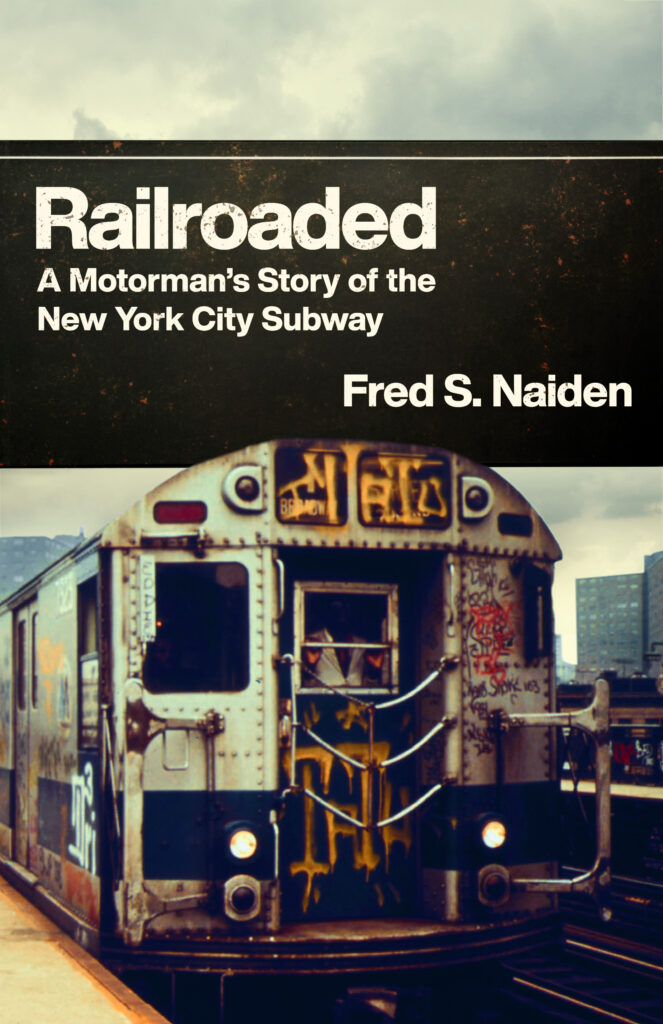
Railroaded: A Motorman’s Story of the New York City Subway, by Fred S. Naiden (New Brunswick, NJ: Rutgers University Press, 2026)
Reviewed by Sean I. Ahern
Railroaded: A Motorman’s Story of the New York City Subway is a memoir of the author’s experience working as a porter, motorman, locomotive engineer (operating diesel work trains) and as a dweller amidst the ruins of the Lower East Side years before gentrification. The author mixes in reflections on the state of the NYC subways with snippets of New York City’s transit history: from the horsedrawn era to the motorized trolley, to the subways and elevated lines. His memoir is expansive, covering an impressively wide range of topics: the Lenape people whose settlements predated the Europeans and the IRT, how geography influenced movement around the boroughs from the days of the Canarsie Tribe, the contentious history of the rank-and-file movement in the Transport Workers Union (TWU) Local 100, remnants of the Communist Party, and cameos of working-class New Yorkers when it was still a working-class city.
Naiden is an Ivy League-educated Professor Emeritus of History at the University of North Carolina, Chapel Hill, who worked in the NYC Transit Authority during the 1980’s. He tried to be a communist before he gave up on the revolution, or at least the party, and went on to earn his PhD in classical languages from Harvard. Naiden followed a circuitous path to a privileged niche. Thankfully he does not presume to offer any lecture to the Transit worker rank and file movements that he was somewhat adjacent to during his relatively brief sojourn into the NYC subway system. He has no ax to grind, or brand to burnish. Railroaded reads like one boomer’s search for meaning.
Naiden has a keen ear for dialogue and excellent recall; his writing is fresh, managing to treat past events he experienced firsthand as if they happened yesterday. Day one in motorman training school began with a bang, as the instructor held up the Metropolitan Transit Authority rule book with one hand, took out a pistol with the other and shot the book before tossing it on the table. The instructor had shot a blank round but made his point to the trainees. The rule book was intact; it wasn’t going anywhere. It was a permanent fixture that governed the job. “Learn it, and if you don’t know, ask.”
The “authority” of the Transit Authority required rules to manage the people that ran the railroad but the system that Naiden described was beset by crumbling infrastructure and deferred maintenance. The TWU Local President, John Lawe, would often say plaintively, “Give us the parts and tools and we’ll fix the railroad.” Naiden’s daughter asked him years after he had resigned, “Daddy…why is it such a mess even though we own it?” Part of Railroaded tries to answer this question.
The Transit Authority rulebook is a thread that runs through Naiden’s narrative and shaped the language of the job: its rules were employed both by management to discipline workers and by workers themselves in their own defense. Management often deliberately misused rules to shift responsibility for accidents, delays and other mishaps onto a worker’s failure to follow the rulebook. Shortly after Naiden was promoted from porter to motorman, a broken signal at New Lots Avenue on the IRT led to the death of Motorman Jessie Cole and injuries to passengers. Supervision alleged that Cole drove his train through the broken signal without radioing ahead, in violation of the rulebook. His coworkers alleged that the radios were often broken and that a flagman should have been placed at the broken signal to control traffic.
Some workers found ways to use the rule book as a form of protest when they “worked to rule, reading the rulebook in the most literal way possible. A concerted effort to work to rule on the part of employees caused delays and all manner of problems for supervision who could not easily charge workers with insubordination for following the rule book. Other workers would draw the line at their own safety and refuse to obey a direct order from supervision if they deemed it to be unsafe. Where the rule on insubordination came up against the safety of a worker, a culture of resistance and direct action grew in the Track and Power Division TWU Local 100, where I worked for 9 years during the 1980s. Naiden only refers briefly to the working conditions in the Track department.
Naiden began his transit career following the city’s 1970s fiscal crisis, shortly before the 1980 strike. His narrative does not follow a sequential timeline, which may be a bit confusing to the reader. He also shifts from memoir to history and socio-political analysis.
Chapter One, “A Motorman’s Work,” begins after he had worked as a porter in the Station Department for a few years following the 1980 strike. Chapter Two, “The Strikes and Deficits that Plague the Subway,” departs from memoir and a personal narrative and relies on secondary sources for background to the 1980 and 2005 strikes in which he played no direct leading or organizing role. Chapter Three, “My life in a Downtown Railroad Flat,” describes a year or so immediately prior to his transit career, during which he bummed his way around the old Lower East Side, encountered aging communists from a bygone era, did some tenant organizing, and joined the Communist Party. Chapter Four, “A Railroad Porter’s Work,” begins in porter “training school.” His training was interrupted by the 1980 strike, which he describes as his first vacation.
Naiden summarizes the context for the 1980 strike that was forced on a reluctant union leadership by an insurgent rank and file. Working conditions and service had deteriorated while inflation soared. Maintenance was deferred. Track fires and crime spread. Contractual concessions that were included in the 1974 TWU Local 100 contract stood in stark contrast to the spirit of the 1966 strike and the martyrdom of “Red” Mike Quill that lingered in the collective memory of some senior union members and second-generation transit workers whose parents had shut the city down during the Lindsay administration. What happened to the spirit of ‘66? Naiden recounts that “some loved the union for what it had been and others hated it for what ‘it had lost.” “Many regarded the local as a company union.” “The Brooklyn men thought the union was theirs to recover.”
Naiden recounts the mood of the workers prior to the 1980 strike by quoting a common refrain heard in break rooms and locker rooms throughout the system: “What the fuck?” A growing cauldron of rank-and-file anger gave rise to a new generation of leaders. Mike Scott was a motorman who ran for the TWU Executive Board in 1977 and pledged to vote against any contract with concessions. Naiden describes his first sighting of Mike Scott with a sense of admiration for the only communist on the TWU Local 100 Executive Board. Arnold Cherry, another rank-and-file leader and second-generation transit worker, was a car maintainer who led workers in the largest IND shop in successful job actions. Henry Lewis, a leader in the rapid transit division, was a transplant from Alabama demoted to conductor from motorman for insubordination who Naiden described as a “great orator” and “the least educated but most knowledgeable.” George MacDonald, a leader in the Coney Island yard, is never mentioned by name but only referred to as the Vietnam vet “who understood wages and pensions but not bonds and bankruptcy.” Unlike the other rank and file leaders, the anonymous MacDonald is described as an anti-socialist.
Leaders in other departments are mentioned only in passing or not at all. One rank-and-file leader who emerged following the 1980 transit strike was a track worker, Roger Toussaint, who entered the system around the same time as Naiden. Why Naiden never attempted to reach out to Toussaint for his account of the rebirth of the rank-and-file movement after 1980 and subsequent events is unexplained and makes for a gap in Railroaded, especially for readers familiar with the history. In Chapter Two, “The Strikes and Deficits that Plague the Subway,” Naiden omitted any review of the numerous talks, interviews and public statements from Roger Toussaint, the most prominent leader of the Transport Workers Union selected by the rank and file that emerged after the 1980 strike. Naiden steps into highly contested terrain and unreflectively bases his account on the anti-Toussaint school of recent TWU history. This shortcoming detracts from an otherwise thought-provoking narrative.
Transit workers moved the city. They had a tradition of unionism that harkened back to the Brotherhood of Locomotive Engineers’ 1918 strike and the Malbone Street crash caused by an untrained scab who derailed the train, causing the deaths of 94 passengers. The Transport Workers Union was established as an industrial union including all crafts prior to the formation of the CIO in the 1930s. The 1966 transit strike had set the standard for all the NYC municipal union organizing that would follow. Many workers remembered what had been achieved and what was being lost. Younger workers had returned from Vietnam with their own memories and fighting spirit. Black and Puerto Rican workers fresh from the struggles against racial and national oppression added to the lingering traditions of revolutionary Irish nationalism, anti-British colonialism and the legacy of James Connolly. Now this group of workers were being forced to give back hard-earned gains. The stage was set for a confrontation that couldn’t be stemmed by the Taylor Law prohibitions against concerted action or the behind-the-scenes collusion of TWU President John Lawe with the Transit Authority and Felix Rohatyn, leader of the financial community.
Railroaded does not track the next wave of organic rank-and-file insurgency that led to the historic victory of Roger Toussaint dislodging the incumbent leadership of Local 100 in January 2001. Nor does it account in any substantive way for the unravelling of the movement that had propelled Toussaint’s victory, beyond the cryptic and imprecise statement that “Toussaint’s critics saw the union as a debating society while Toussaint saw it as an army.”
There are no regrets or shocking revelations in Naiden’s narrative. His memoir is neither belabored with a “God that Failed” repudiation of communism nor is it a brief for one or another competing radical sect. His own Communist Party club seems to have dissolved shortly after he became a motorman in the early 1980’s. Railroaded offers no heroic portrayal of the prototypical proletarian nor diminution of the union’s value to workers’ well-being under some pseudo radical critique of reformism. At its best, Naiden’s memoir offers a sympathetic, authentic, nuanced picture of his coworkers and the challenges of their jobs.
Present day “salts” may dismiss Railroaded as too full of despair and too short on solutions, for the author neither proposes nor suggests answers for would-be labor radicals or even his own daughter’s probing questions. This “Motorman’s Story” is no manual for self-organization, for strike strategy and tactics, or union democracy. To Naiden’s credit, he listened, and shares with us what he saw and heard. The narrative loses focus, however, when he digresses from those direct experiences and fails to examine them more closely.
From his vivid descriptions of conditions and dangers which he encountered as a worker and a rider in the years following the NYC fiscal crisis, it is understandable why he quit. He had been “railroaded” as an employee but the prospect of running over a civilian was too much to bear. A careful reader might wonder why he did not consider alternative positions as train dispatcher, tower operator or conductor, that did not put him at the controls of a train.
What drove the author, a child of professional parents and an Ivy League graduate raised in the leafy suburbs of Washington DC, to clean toilets in Grand Central Station and to live in a crumbling tenement in the shambles of the Lower East Side? Given the author’s quite dissimilar background to that of most NYC transit workers, it is a fair question that is left unanswered.
Naiden’s need for a job and later his fear of running someone over while operating a train are understandable reasons for why he took the job in the first place and later why he left, yet on reflection the reasons seem to conceal more than they reveal. His statement in the preface that “I am the man with a million names – a railroad man. A man with his own number, like a con” is hyperbolic and occludes much of the author’s internal dialogue.
Naiden satirizes the Transit Authority’s requirement that written reports, called G-2s, be submitted about every infraction or incident in which a transit employee is involved in or observes. Early on, he had been advised by co-workers that the less said, the better in a G-2, hence the most common report: “No knowledge.” Later, as a shop steward in the Station department, his academic skills helped him win a significant back pay grievance for his co-workers and to add a dash of Ivy League vocabulary to G-2 reports that managed to say little of substance. If the supervisor asked you to report on what you heard, Naiden’s suggested response was: “I have no knowledge because of circumambient noise.” If they asked you what you saw, he suggested: “I have no knowledge because of occluded sight.” As a shop steward for porters, he came to be known for his G-2 writing skill and was referred to fondly by some as “the G man.”
Naiden formed meaningful relationships with his coworkers and seemed to be in the process of changing his class identity before he resigned and joined the ranks of tenured academia. When he switches from direct experience to describe the rank-and-file movement that emerged after the 1980 strike, to which he no longer had a direct connection, he loses the thread of working-class life, and the result is neither a vivid memoir nor compelling history. There is a passing reference to workers in the car barns as “fragmented by race, borough, division and outlook.” The fragmentation wasn’t limited to the car barns, yet Naiden omits any reference to how the rank-and-file movement that emerged after the 1980 strike sought to overcome those divisions. Was no effort made or was the author blind to them?
The preeminent NYC labor historian Joshua Freeman is referenced in the notes to Chapter Two and offers a generous jacket comment to Railroaded. However, Freeman’s excellent article on the 2005 strike (“The Anatomy of a Strike. New York City Transit Workers Confront the Power Elite,” New Labor Forum 15.3 (2006): 9-19) is incorrectly prefaced in the notes on page 252 as describing “The failure of the 2005 strike.” Freeman’s article, however, carefully avoids such a characterization of the 2005 strike. Naiden has unreflectively adopted the “failure” assessment employed by what some transit workers have described as the “cappuccino socialists.”
Whatever criticisms may be made of his tenure, the “failure” label is a particularly inappropriate characterization of Toussaint’s leadership as rank-and-file leader and TWU President. After leading a historic victory over an entrenched union bureaucracy in December 2001, Toussaint successfully navigated the newly elected rank-and-file leadership through the treacherous terrain created by the fallout from the attacks of September 11, 2001. He led contract negotiations while the pile that was once the World Trade Center was still smoldering. Transit workers had lost friends and family, and the TWU International threatened Local 100 with being placed under receivership to preempt a government takeover under the Patriot Act if the union struck – which the members seemed ready to do. Three years later, in the 2005 strike, when municipal unions were running for cover under the Bloomberg regime, Toussaint and the now sorely divided TWU managed a credible defense and proudly wore Bloomberg’s racist epithet aimed at UFT leaders and members, “UNION THUG,” as a badge of honor.
The description of the murder of Willie Turks in 1982, a Black worker at the Coney Island yard on his way home after work, at the hands of a gang of white thugs, is noted in a paragraph without commentary on how transit workers responded. Naiden ignores the decision of the Track and Power division, chaired at the time by Benny Foster, to carry the TWU Local 100 banner in a memorial march led by Reverend Al Sharpton, down Avenue X past the Coney Island shop. This affirmation of solidarity supported a rank-and-file revival in the Track and Power Distribution Division. Foster, a Korean War era veteran and former activist in CORE, had been a leader in the 1980 strike and was elected and reelected as the Division Chairman after the strike. Other former leaders of the 1980 strike, including Mike Scott, the self-described communist, refused to endorse or join the march.
Naiden has done his homework on the MTA and justly rails against private interests that are using a publicly held Authority to enrich themselves. The trains are ours, but we don’t control them. He suggests that property taxes should be based on proximity to the subway. He invokes an old communist idea that everyone should ride for free. He concludes that New York State created the MTA and should abolish it. He cites the Municipal Home Rule Law of 1963 that empowers the city to repossess the railroad and run it as a public utility like the police and fire departments. It would be interesting to know if Mayor Mamdani has investigated the possibility. With no offence to the well-intentioned efforts of our new Mayor, it will be a welcome day when the people of NYC can move from virtue-signaling to actually confronting elite power as an organized force, the way Transit Workers did in 1966, 1980, and 2005.
The rank-and-file movement that reemerged while Naiden worked for Transit in the 1980s propelled Roger Toussaint to leadership. The challenges that their movement faced, though poorly accounted for in Railroaded, provide lessons that will be of most value to future generations of NYC transit workers and students of the class struggle.
Transit workers will reemerge once again out of necessity, hopefully made wiser by experience and past practice, and less prone to faction, to challenge elite power, hopefully with greater support from the labor movement.
I can’t say if these workers will find anything of use in Railroaded, but I think, as one whose heart will forever be with them, and in fairness to the author, it is worth a read.
Reviewed by Sean I. Ahern. In the 1970’s I was a postal worker and active in the Metro Area Postal Workers Union (APWU). In the 1980’s I was a Track worker, Division Vice-Chair and delegate to the 1984 Transit Workers Union International Convention. In the 1990s I worked as line cook and chef. Starting in 2000 I taught Culinary Arts in NYC high schools and was active in the UFT. I have three grown children and am enjoying retirement with the help of a defined benefit pension plan, Social Security, Medicare and rent control. I reside with my wife on the Lower East Side where I was raised. My previous reviews include; Theodore W Allen’s The Invention of the White Race (2 vols), Jeffrey Perry’s biography of Hubert Harrison (2 vols) and Jerald Podair’s The Strike That Changed New York.