
Starting from Paterson
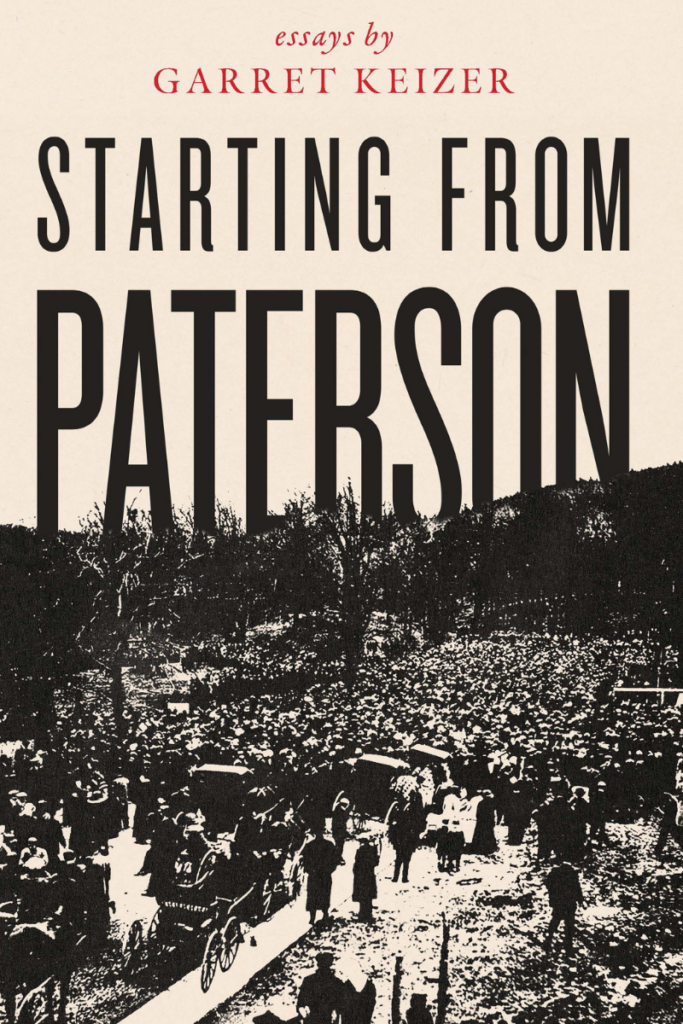
Starting from Paterson, by Garret Keizer (Rochester, MA: Eastover Press, 2026)
Reviewed by Keith Danish
Your reviewer came across the new book Starting from Paterson1 serendipitously, in a New Jersey public library. The author’s name seemed familiar, and then I remembered that our Association had awarded a Debra Bernhardt Labor Journalism Award to Mr. Keizer in October 2017, for his essay, Labor’s Schoolhouse: Lessons from the Paterson Silk Strike of 1913.”2 That essay is reproduced in Keizer’s new collection, along with eight others that relate directly or thematically to Paterson and Haledon, New Jersey.
Starting from Paterson is Garret Keizer’s tenth book, and his essays have been published widely. He was born in Paterson and raised in the nearby town of North Haledon, adjacent to Haledon, the latter being the home of the American Labor Museum / Botto House as well as the town where his wife-to-be grew up. The Botto House is the institution identified as “Labor’s Schoolhouse” in the aforementioned prize-winning essay. While Keizer has lived with his family in rural Vermont for the past 40+ years, his origins continue to shape his work and worldview, and he acknowledges that “I’m not so much a Vermont writer as a New Jersey writer-in-exile.”3
From the balcony of the Botto House, notorious IWW leaders like Big Bill Haywood, Elizabeth Gurley Flynn, Carlo Tresca and Patrick Quinlan addressed the strikers from the Paterson silk mills in 1913. Paterson’s police had shut down the workers’ meeting halls, but the Botto family in Haledon allowed their home and surrounding hillside to become an alternate meeting place. The Socialist Mayor of Haledon, William Brueckmann, also cooperated with the strikers. Keizer’s essay reviews the strike’s history and context, and the role of the Botto family, and it is noted that Paterson had a history of labor agitation as well as socialist and anarchist politics. Today, the Botto House preserves labor history but also specializes in outreach programs to teach that history in schools and other venues, and in-house. The house was declared a National Historic Landmark in 1982.
While “Labor’s Schoolhouse” may be the highlight of the book for a labor history audience, there are other incisively written essays and my favorite is “Florence of Paterson,” about the author’s grandmother, who often took Keizer on her “daily foraging expeditions to Paterson,” where she had grown up and would continue to visit even after her children warned that it was unsafe. Keizer uses the word “heterodox” to describe both Paterson and his grandmother and the common place they hold in his imagination.
Other essay topics include food-shopping, the music of Motown, going to church, meeting celebrities, and searching for true north, with Keizer finding the extraordinary in the ordinary, as one critic remarked.
When he accepted our Bernhardt Award, Keizer expressed hope that the appearance of his essay in a prominent publication would educate the public and union members about the benefits that they enjoy because of the struggles of the labor movement. His essays do make manifest his ground-level understanding of the lives of working people, especially “Walt,” his beloved father-in-law who lived in Haledon, worked in Paterson, and was an unselfish “caretaker” of family, friends, and neighbors. You won’t see Keizer write abstractly about strange denizens of “flyover country,” he was not brung up to do such a mean thing.
In conclusion, your reviewer now discloses his bias in favor of artistic output connected with Paterson; it’s an aged, too-shabby city4 with excessive poverty and crime, but near the heart of town flows the glorious “Great Falls,” sculpted from glaciers, with the second-largest water volume of any waterfall east of the Mississippi River. And nearby are the remnants of old mills that once harnessed water power from the Great Falls to run industries as a result of Alexander Hamilton’s vision for an industrial city, a dynamic economy, and a growing nation. And throughout the town are the immigrant communities, they have come in waves to make the nation stronger and richer, first Irish, Italian, Eastern European, now Puerto Rican, Dominican, Peruvian, Turkish, Middle Eastern, Bangladeshi. (The current Mayor of Paterson is the Catholic son of a Syrian mother and a Lebanese father.) And these communities have produced a cornucopia of “ethnic” restaurants, cafes and food trucks. Perhaps the works of art and literature produced in such an environment are like grasses coming up through the cracks of a worn sidewalk; they are determined to live and thrive. So, I welcome Keizer’s addition to the Paterson “oeuvre,” alongside William Carlos Williams’s epic poem “Paterson,” Jim Jarmusch’s movie “Paterson” (about a bus driver/poet named “Paterson”), the working-class-attuned comedy of Paterson-born Lou Costello, the “Howl” of Paterson-raised poet Allen Ginsberg and, of course, the Paterson Strike Pageant to support the silk workers’ strike of 1913. I hope that serendipity or karma will lead me to other artistic emanations from “Silk City.”
Reviewed by Keith Danish, the Book Review and Newsletter Editor of the New York Labor History Association.
- The title recalls Walt Whitman’s poem, Starting from Paumanok. ↩︎
- The essay first appeared in the July 2017 issue of Harper’s Magazine. ↩︎
- One critic borrowed a Rutgers University slogan to describe Keizer’s work: “Jersey Roots, Global Reach.” ↩︎
- Paterson is New Jersey’s third-largest city, with a population of around 160,000 people. ↩︎