
Hollywood Unions
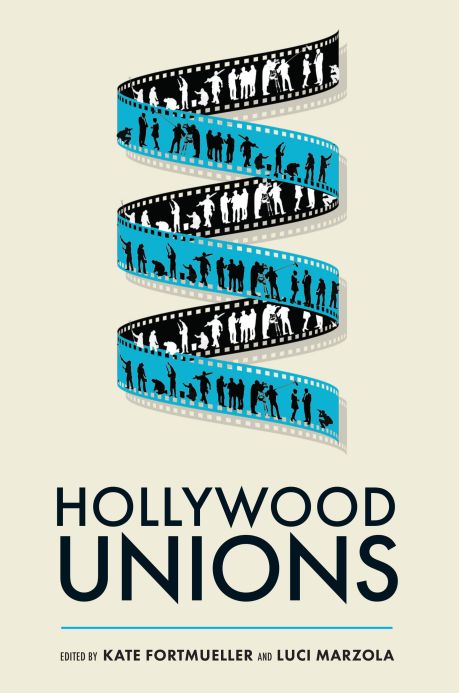
Hollywood Unions, edited by Kate Fortmueller and Luci Marzola (New Brunswick, NJ: Rutgers University Press, 2024)
A Century of Collaboration and Disruption
Reviewed by Michael Tubridy
When it comes to labor unions in Hollywood, people are most likely to think of the more high-profile ones, such as the Writers Guild of America (WGA) and SAG-AFTRA, which brought the industry to a standstill with strikes in 2023.
Hollywood Unions demonstrates how much more widespread these organizations are. It’s not only that, as editors Kate Fortmueller and Luci Marzola remind us, any given production “involves members of more than a dozen unions,” but also that “In no other industry do so many different crafts and different unions come into contact—let alone collaborate—with each other.”
All but one of the 11 chapters focus on different occupations. While the last few deal with the better-known “creative” guilds, such as SAG-AFTRA, the WGA, and the Directors Guild of America, the first two-thirds concentrate on the so-called “below-the-line” unions, generally associated with more blue-collar, less prestigious livelihoods, notably the International Alliance of Theatrical Stage Employees (IATSE). That wide-ranging coverage implicitly refutes many conservatives’ contention that Hollywood unions cater to elites with concerns far different from those of average Americans.
This organizational structure enables the book’s contributors to concentrate on their areas of expertise and readers to see how each occupation responded to challenges unique to their situations. Nevertheless, episodes (e.g., McCarthyism) and issues (employment and income disparities involving race and gender) recur and can sound redundant, which would not be the case with a more conventional chronological narrative.
Not only are there many unions representing an estimated 331,000 workers in the film and television industry, but they have undergone so many mergers and name changes that the acronym list at the front of the book is not just a welcome feature but an essential one in comprehending this history.
For all its insights, this essay collection could have been more reader friendly. Brief biographies of colorful or significant union members such as Ronald Reagan, Ed Asner, Herb Sorrell, and the disreputable Willie Bioff of IATSE, for instance, could have been used as pegs to lure readers into chapters.
Moreover, editors Fortmueller and Marzola could have wielded the blue pencil more vigorously on some passages. The suffixes “ization” and “izing” appear in sometimes unusual and unnecessary instances (“proletarianizing,” “logic of feminization”). An occasional clotted sentence also creeps in, such as this one:
“This historical episode points to how generational attitudes in DGA leadership shape the culture of the guild as it handles large social, political, and industry-specific issues that demand a public-facing stance that might be tangled up in a romanticized notion of organizational identity and the very real, day-to-day needs of its members.”
Despite such weaknesses, Hollywood Unions rewards patient reading. Its contributors—academics, an archivist, and a media research analyst—have drawn on multiple sources to illuminate a century of union struggle in this company town—and to explore how much the 2023 strikes might portend a new era of solidarity in what Fortmueller calls a “codependent ecology” among these groups.
Prior Hollywood histories such as Nancy Lynn Schwartz’s The Hollywood Writers’ Wars extensively documented major studios’ clashes with unions in the Thirties and Forties. But the essays compiled by Fortmueller and Marzola also detail how unions have grappled with less blatant (but increasingly successful) recent attempts to outsource production to nonunion freelance units, as well as jurisdictional disputes involving overlapping constituencies.
For all the glitz of stars and large and small screen products, the work behind them is often gritty, unglamorous, unremunerative, and, at times, unsafe. (Dangers existed not just during stunt work and COVID, but also when hauling and taking down heavy, awkward equipment and sets.)
Like other industries, Hollywood’s unions have experienced technological disruption, with the silent-to-sound transition the most legendary. But also highlighted here are less obvious ones such as the postwar sound recording switch from optical recording to magnetic tape, flatbed editing systems such as the KEM that made editors less dependent on assistants, new distribution channels such as the VCR, the DVD, and streaming that called for new calculations of shared profits and residuals, and, more recently, the specter of artificial intelligence with its potential for revolutionary changes in “content” creation, production and dissemination.
This account went to press in late 2023, just before the following year’s election, so by necessity it doesn’t account for how the current political landscape (and Paramount’s potential acquisition of Warner Bros. Discovery) may affect employment in the film and TV industry. It would be ironic indeed if President Trump’s tariff policies that threaten the industry’s markets led unions and producers to put aside their long-standing differences.
Reviewed by Michael Tubridy, author (with Robert Polner) of An Irish Passion for Justice: The Life of Rebel New York Attorney Paul O’Dwyer. He also writes extensively on film, television, and union history on his blog A Boat Against the Current.