
Women, Immigrants, and the Working-Class Battle in Little Falls, New York: The Textile Strike of 1912-1913
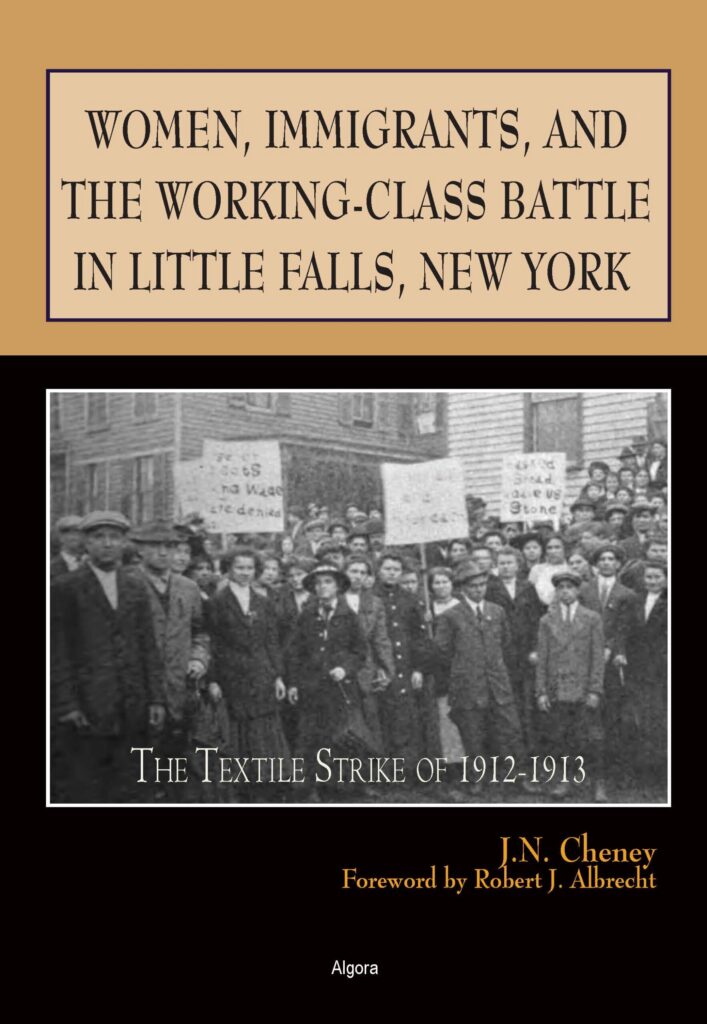
Women, Immigrants, and the Working-Class Battle in Little Falls, New York: The Textile Strike of 1912-1913, by J.N. Cheney (New York, NY: Algora Publishing, 2025)
Reviewed by Steven Davis
Historian J.N. Cheney presents an extensively researched, richly detailed history of the 1912 strike of textile workers in the New York Mohawk Valley city of Little Falls.
Labor unrest was not unknown in Little Falls, but this strike differed dramatically from events there 26 years earlier. In 1886, all 20,000 employees of the knitting mills in the Mohawk Valley, including Little Falls, were locked out of their jobs by their employers. Their offense was their membership in the Knights of Labor, the first national labor organization.
The outcomes of the two labor-management confrontations could not have been more different. In 1886 the employers hired replacements for all the locked-out workers and destroyed the Knights’ local union. In contrast, in 1912, the workers engaged in a fierce three-month struggle with the help of nationally known unions and sympathetic former local officials. They won increased wages and changes to the piecework system and became represented by two national labor unions.
The strike took place in an era of oppressive working conditions, highlighted by major labor industry disasters. The Triangle Shirtwaist Factory fire, resulting in the deaths of 146 primarily immigrant female garment factory workers, prompted laws providing for occupational safety. In another contemporary event, known as the “Uprising of the 20,000,” also in New York City, employees struck in protest of low wages, poor working conditions and oppressive hours of work.
The book effectively traces the history of the labor movement in the early 1900’s. The theme was consistently, sickeningly similar: immigrant workers, mainly young women and girls in big cities such as New York and in small cities such as Little Falls, New York, Paterson, New Jersey and Lawrence, Massachusetts, worked burdensomely long hours in unsafe, overcrowded mills for extremely low wages. Their dilapidated, hazardous tenement housing, intolerably overcrowded with little or no plumbing, sanitary or toilet facilities, contributed to the occupants contracting tuberculosis and other diseases. Nurse Helen Schloss was hired to report on the squalid living conditions in Little Falls and soon became an important supporter of the workers’ struggle for improved conditions.
The 1912 strike began as a result of a New York State law which limited hours of work for women from 64 to 50 per week. Employers reduced the pay of those workers accordingly. Thus, employees were earning less money than before the new law. Workers struck in protest of the reduction of their wages.
The strikers were joined by organizers of the Industrial Workers of the World (the “Wobblies”) which established a local union there. The Socialist mayor of Schenectady also joined their ranks. IWW officials “Big” Bill Haywood and Matilda Rabinowitz came to Little Falls in support of the strike. Helen Keller supported their cause. The American Federation of Labor also organized a Textile Workers of America local union which competed with the IWW for members.
In a dramatic development, similar to what occurred in the Lawrence strike, 18 children of strikers were sent by train to the homes of strike sympathizers in nearby cities.
The strikers were met with great opposition from Little Falls politicians, media outlets and police who were sympathetic to the mill owners. The local police, employer-hired strikebreakers and special police arrested demonstrators attempting to speak at rallies. There were also violent confrontations between the strikers and the police in which pickets were beaten.
The three-month strike was settled by the intervention of the New York State Mediation Board. Hearings were held at which numerous witnesses testified as to the causes and nature of the strike. The Board recommended and the parties agreed that employees working 54 hours be paid for 60 hours, piece work rates were adjusted, and all former workers reinstated.
Following the settlement certain strikers were convicted of assault and imprisoned. Others were acquitted.
The author skillfully relates elements of early oppressive working conditions to today’s labor strife. For example, he compares the “overly surveillant” and “strict control” over the basic functions of the Triangle workers to today’s Amazon workers being “incessantly traced and monitored throughout the day by their supervisors leading to situations similar to those faced in the Triangle factory.” He also relates that nurse Schloss operated a soup kitchen during the strike and 95 years later the AFL-CIO brought striking workers free food for Thanksgiving. Both were similar gestures made during distant times but having the same effect.
Rather than simply reciting the facts of the strike the author delves deeply into the sociological aspects of the work stoppage. For example, he explores the dichotomy between the IWW’s espousal of “revolutionary socialism” and its “reactionary adherence to patriarchal gender” identification.
Further, in this regard, I credit the author for questioning the credibility of events as reported in the press. Thus, he examines whether certain facts as reported in newspapers at that time ring true, for example whether Schloss was assaulted by the police chief when she asked to see the prisoners.
In addition, he perceptively examines whether the jurors hearing the cases of the strikers accused of criminal misconduct were biased because of their ethnicity. Using a modern website search he learns that the published names of the jurors which suggest that they are “Anglo-descendent” may underlie a prejudice against the Southern and Eastern European immigrant defendants. In addition, the published occupations of the jurors — farmers, clerks, a guide and a shoemaker — constitute a distinctly different work and living experience than those accused and may have contributed to their bias.
The book is an excellent study of an important event in early 1900’s labor history and, in today’s environment, a significant study of working immigrants’ acceptance in American society and their relation to native-born people.
Reviewed by Steven Davis, a member of the Executive Board of the New York Labor History Association and a retired Administrative Law Judge with the National Labor Relations Board.